
Does your content marketing feel like you’re just throwing spaghetti at the wall and hoping something sticks?
You write a blog post. You post on social media. You send an email. Crickets.
I get it. I’ve been there, and it’s beyond frustrating. It feels like you’re working hard but going nowhere fast, burning through time and resources with little to show for it.
Let’s be honest with each other, content without a clear purpose is just adding to the noise.
Before I was a marketer, I was a mechanical engineer. I spent my days designing complex systems that had to work flawlessly. There was absolutely no room for guesswork. We needed a blueprint, a schematic, a plan where every single component had a purpose.
When I moved into marketing, I saw a lot of brilliant, creative people throwing spaghetti. I realized that creativity was enough in the ecosystem, but it needed a solid content strategy framework. My engineering mindset was helping me there.
That’s what this guide is. It’s the blueprint. It’s the schematic for your content machine.
I’m going to give you the exact, step-by-step framework to stop guessing and start engineering a content engine that consistently helps you build your audience. It will also earn their trust and grow your business.
Let’s get to work.
Chapter 1: The Strategic Foundation (Your Blueprint)

Before we build anything, we need a blueprint. In content, that blueprint is your strategy, and it starts by answering one question: “What business problem are we trying to solve?”.
In other words, every piece of content must have a job to do.
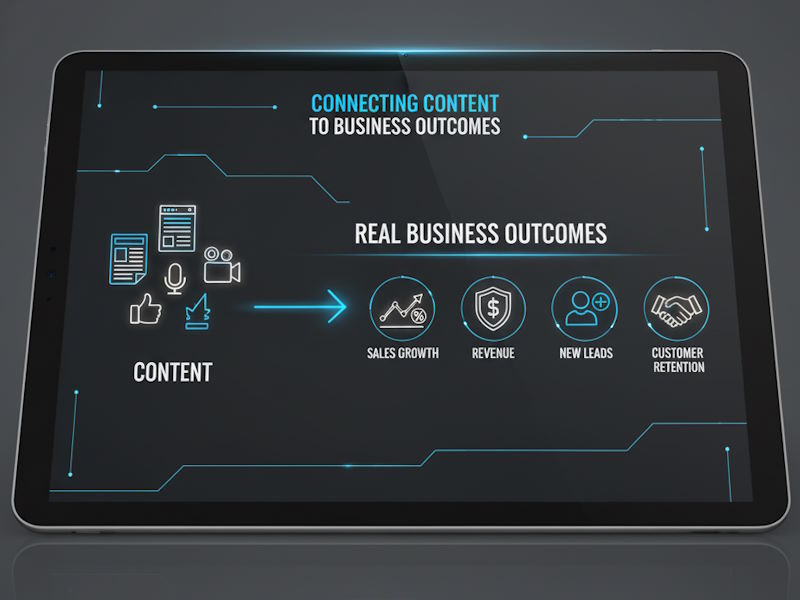
Connecting Content to Real Business Outcomes
For years, marketers got away with measuring success with “vanity metrics” like page views and likes.
Those days are over.
Now, success is measured in “real business outcomes.” We’re talking about metrics like clean leads and closed sales. And also direct user actions like sign-ups and calls.
Your content needs to be an engine for business growth. We are not working on a creative side project anymore.
To do that, you must align your content with one of these five core business imperatives:
- Increase Brand Awareness & Manage Reputation: Building trust so your brand is the first one people think of when they’re ready to buy.
- Generate High-Quality Leads: Attracting potential customers who are a good fit for what you sell.
- Enhance Customer Engagement & Retention: Keeping existing customers loyal, which reduces churn. It also increases their lifetime value.
- Establish Thought Leadership & Authority: Becoming the definitive, trusted expert in your industry.
- Drive Sales Conversions & Revenue: Directly influencing purchasing decisions and proving that your content is making money.
To cut it short, you have to choose a job for your content before you create it.
Setting Goals with the S.M.A.R.T.E.R. Framework
Once you know the “job,” you need to define what success looks like. Here, the S.M.A.R.T. framework is our starting point.
Your goals must be:
- Specific: Clear and unambiguous.
- Measurable: Trackable with real numbers.
- Achievable: Realistic given your resources.
- Relevant: Aligned with the big-picture business strategy.
- Time-bound: Tied to a deadline, like the end of the quarter.
But a change is needed here. The market moves too fast for a “set it and forget it” plan. We need to upgrade to S.M.A.R.T.E.R..
The “E” and “R” stand for Evaluated and Reviewed.
This means your strategy is a living system you review constantly. It can be monthly, bi-weekly, or whatever it takes to review to “kill what’s not working” and double down on what is.
Here’s an example of a S.M.A.R.T.E.R. goal in action:
“To generate more qualified leads, we will host one expert-led webinar per month in Q3. Success is a 40% increase in MQLs from our webinar program. We will review lead quality with the sales team bi-weekly to adjust our promotional targeting”.
That’s an engineered plan.
Mapping Content to the Full Customer Lifecycle
A customer’s journey doesn’t start when they’re ready to buy, and it certainly doesn’t end after the sale. Your content needs to meet them at every stage. The stages are:
- Awareness Stage: Here, people are just realizing they have a problem. Your content should attract and educate them without talking about selling them anything. Think educational blog posts, podcasts, and short-form videos.
- Consideration Stage: Now they’re actively researching solutions. This is where you build trust with in-depth, authoritative content like comprehensive guides, case studies, and webinars.
- Decision Stage: They’re close to buying but have final questions. Your content should build confidence with customer testimonials, demo videos, and detailed buyer’s guides.
- Loyalty & Advocacy Stage: The journey isn’t over! Content for existing customers is key to increasing retention and turning them into brand advocates. Examples here are advanced user guides and community initiatives.
When you map your content to this full lifecycle, you create a cohesive experience. This experience helps you win a sale and build a loyal relationship.
Chapter 2: Audience Intelligence (Your Compass)
You can’t build a solution if you don’t understand the problem. The foundation of any winning strategy is a deep understanding of your audience. But deep is not enough. It should be empathetic and data-driven, too.
We have to go beyond who they are and understand why they do what they do.
From Demographics to Psychographics
Knowing your audience’s age and job title isn’t enough. We need to uncover their core motivations.
- Psychographics: What are their values, interests, and lifestyles? This reveals the “why” behind their choices.
- Pain Points: What are their biggest frustrations and obstacles?
- Goals: What does a “win” look like for them?
- “Jobs-to-be-Done” (JTBD): What “job” are they hiring your content to do for them? Are they reading your article just trying to look smart in a meeting? Are they trying to justify a purchase? Or maybe they want to fix a problem with the help of your educational article.
To get these answers, you need to become a digital anthropologist.
- Direct Research: Talk to people. Run one-on-one interviews. These kinds of interviews are the best tools for finding real challenges. And don’t just talk to happy customers. Unhappy ones often reveal the most critical insights.
- Indirect Research: Analyze the digital breadcrumbs they leave behind. Use social media listening to track conversations. Review customer support tickets and sales call notes to find recurring themes.
This process is about finding the strategic gap between what your audience desperately needs and what your competitors are failing to provide.
A Step-by-Step Guide to Building User Personas

All this research comes together in a user persona. A persona is a fictional character you create to represent a key segment of your audience. It’s a data-driven archetype, not a stereotype, that makes your audience real and relatable. These are the steps to follow when building the persona.
- Step 1: Research & Consolidate: Gather all your interview transcripts. Besides, gather survey data and analytics reports in one place.
- Step 2: Find Patterns: Analyze the data to find recurring behaviors. Look for goals and pain points, too. Group users with similar traits into 3-5 distinct segments.
- Step 3: Build the Persona Profile: For each segment, create a narrative that brings them to life. It should include:
- A name and a representative photo.
- Their psychographic profile (values, motivations).
- Their primary goals and biggest challenges.
- A short story about their typical day.
- Real, verbatim quotes from your interviews to add authenticity.
- Step 4: Validate & Socialize: Share the draft personas with your sales and customer support teams. They talk to customers all day and can tell you if you’ve hit the mark.
Finally, remember that personas are not static documents. You are not engraving them on steel or stone that can’t be changed. The market changes, and so do your customers. You must have a process to review and update your personas regularly to keep them relevant.
Chapter 3: Competitive Intelligence (Your Radar)
Your strategy can’t be created in a vacuum. You need a systematic and ongoing analysis of your competitive landscape to find opportunities. The goal is to differentiate your brand.
And your competition is much broader than you think.
Identifying Your Four Tiers of Competitors
A common mistake is only looking at companies that sell the same product as you. In the battle for audience attention, you have four different types of competitors:
- Tier 1: Direct Competitors: The obvious rivals selling similar products to a similar audience.
- Tier 2: Organic Search Competitors: These are the websites that rank for your target keywords, even if they don’t sell a competing product. This often includes media outlets and industry publications that are masters of content.
- Tier 3: Paid Search Competitors: The brands bidding on your most valuable keywords. They show you which terms are perceived to have the highest commercial intent.
- Tier 4: Local SEO Competitors: For businesses with a physical footprint, these are the rivals that appear in local search and map search.
Tools like Semrush are essential for identifying who is in each of these tiers.
Conducting a Competitor Content Audit
Once you know who you’re up against, you need to audit their playbook. Follow the steps below:
- Content and Keyword Gap Analysis: Identify valuable keywords your competitors are ranking for that you are not. This provides immediate content opportunities. In this step you must analyze volume and the search intent behind each keyword.
- Backlink Profile Analysis: Backlinks are “votes of confidence” from other websites. Analyzing who links to your competitors gives you a roadmap for your own link-building strategy. Useful data: top-ranking pages have, on average, 3.8 times more backlinks than pages ranking lower.
- Qualitative Content Review: Go beyond the numbers. What types of content are they creating (videos, blogs, podcasts)?. Is it deep and well-researched or shallow and superficial?. What is the voice and tone?.
The goal of this intelligence operation is to find their weaknesses and translate them into your wins. If they’ve ignored a high-value topic, that’s your chance to own it. If their brand voice is bland and corporate, you can win by being more authentic and human.
Chapter 4: Building Topical Authority (Your Moat)
The single biggest shift in SEO is the move from keywords to topics.
Search engines like Google now understand meaning and the relationships between concepts. To win, you must become the definitive resource for an entire subject area. This is called topical authority, and it’s your competitive moat.
The Pillar-Cluster Model: Structuring for Dominance
The most effective framework for building topical authority is the pillar-cluster model.
Think of it as creating an encyclopedia on your website. The critical elements for this model are:
- Pillar Page (The Hub): This is a single, massive piece of content covering a broad topic from end to end. It targets a high-volume search term like “content marketing strategy”.
- Cluster Content (The Spokes): These are multiple, in-depth articles that explore specific subtopics related to the pillar, like “how to create a content calendar”.
- Internal Linking (The Connections): This is the magic. Every cluster post links up to the pillar page. The pillar links out to all its clusters. This architecture signals a deep semantic relationship to search engines, establishing your authority over the entire topic.
A competitor might be able to create one good article, but it’s incredibly difficult for them to replicate an entire, interconnected content ecosystem.
Mastering Semantic SEO
Semantic SEO means optimizing for meaning, not just keywords.
- Focus on User Intent: Every search has a purpose. Your content must match the dominant intent for a query or it will struggle to rank. The intent can be informational, commercial, or transactional.
- Optimize for Entities: Google’s Knowledge Graph is a huge database of real-world “entities” (people, places, concepts). You need to clearly reference these entities in your content and use structured data (schema markup) to explicitly tell search engines what your content is about.
- Write for Natural Language: Search engines now understand conversational language. Write naturally, answer common questions directly, and use long-tail keywords that reflect how real people talk and search.
The ultimate goal is to become the citable source for Google’s AI Overviews. By creating the most authoritative, well-structured, and contextually rich content, you position your site as the ideal source material for these AI-generated answers.
Chapter 5: The Content Matrix (Your Toolbox)
The world is drowning in content. As a result, the format you choose is a critical strategic decision. The new imperative is value density over volume. It’s about maximizing the value you deliver per minute of your audience’s attention.
The ROI of Video
Video remains dominant, but different formats have different jobs.
- Short-Form Video (Reels, TikToks, Shorts): This format is king for top-of-funnel brand awareness and reach. 21% of marketers say it delivers their best ROI. Don’t forget that authenticity is key and unscripted, genuine content often performs best.
- Long-Form Video (YouTube, Webinars): This format is crucial for the consideration and decision stages. Nearly half of marketers use it to provide detailed product information. High production quality is essential here to maintain credibility.
The Power of Audio and Written Content
- Podcasts: Audio is a powerful way to reach audiences during screen-free moments. Reports say 46% of weekly podcast listeners have bought something they heard advertised on a show.
- Long-Form Written Content: Despite the rise of video, in-depth written content remains the cornerstone for building topical authority and ranking in search engines. Data shows that longer pages generate 3x more traffic and 3.5x more backlinks. The key here is value density, It means your content has no fluff, just well-researched, well-structured information.
The Engagement Engine: Interactive & UGC
Static content is no longer enough. You need other formats, too:
- Interactive Content: Quizzes, polls, and calculators transform passive consumption into an active experience, boosting engagement and gathering valuable audience data.
- User-Generated Content (UGC): Featuring content from your customers, like reviews and social media posts, is a powerful way to build authenticity and social proof.
The smartest approach is to “create once, distribute forever”. Start with a pillar piece of content, like a webinar, and then repurpose it into dozens of smaller assets for different channels.
Chapter 6: Human-AI Symbiosis (Your Co-Pilot)

Generative AI isn’t a replacement for human creativity. It’s a powerful partner. When used correctly, it can boost efficiency and free up your team for high-level strategic work.
AI can be integrated across the entire content lifecycle:
- Ideation: Use it to accelerate keyword research and generate topic cluster ideas.
- Creation: Let it generate the “first draft” based on a detailed, human-created brief.
- Optimization: Use AI-powered SEO tools like Surfer SEO to analyze your draft and get data-driven recommendations for improvement.
- Personalization: Leverage AI to deliver hyper-personalized website and email experiences at scale.
The biggest risk of AI is creating generic, soulless content that sounds like everyone else’s. As more companies use the same tools, a genuine brand voice becomes a powerful differentiator.
To avoid this “sea of sameness,” you must implement a “human-in-the-loop” protocol. No AI-generated content should ever be published without a human expert editing, fact-checking, and completing it with your brand’s unique perspective and proprietary insights.
Important note: AI can’t replicate original research, deep expertise, or real-world experience. It only frees you up to focus on the human elements that truly create a competitive advantage.
Chapter 7: Execution & Measurement (Your Engine)
A brilliant strategy is useless without a strong operational framework to execute it consistently.
Distribution: The Omnichannel Imperative
Creating great content is only half the battle. You need a strategic distribution plan to get it in front of the right people.
The old “one-size-fits-all” approach of cross-posting the same message everywhere doesn’t work anymore. You need to craft platform-native experiences, tailoring your content to the unique formats and audience expectations of each channel.
The key is to repurpose, not just repost. Take a core pillar asset, like a research report, and “atomize” it into dozens of smaller pieces: an infographic, a series of blog posts, social media graphics with key stats, and short video clips.
Operations: Calendars and Workflows
A documented production workflow is the assembly line for your content. It ensures every piece moves smoothly from ideation to publication. This includes phases for briefing, creation, editing, design, approval, and promotion.
The content calendar is the backbone of your operation. It’s your central source for planning and coordinating everything, ensuring a consistent publishing process. Whether you use a simple Google Sheet or a sophisticated tool like Asana or ClickUp, the key is to have a system.
Measurement: From Vanity Metrics to ROI

The final and most critical stage is measurement. This is where you prove your value.
You must track KPIs that map to each stage of the customer journey:
- Top-of-Funnel (Awareness): Track reach, audience growth, and SEO visibility.
- Mid-Funnel (Engagement): Track time on page, content downloads, and lead generation.
- Bottom-of-Funnel (Conversion): This is what matters most. Track lead-to-customer conversion rates and, crucially, content-attributed revenue.
To calculate your true content ROI, the formula is simple:
ROI = (Revenue Attributed to Content – Cost of Content) / Cost of Content
Measuring the cost is straightforward. Attributing the revenue is more complex and requires an attribution model to understand how different content touchpoints contribute to a final sale.
My Biggest Mistake (And What I Learned Managing Content for 40 Million Users)
Early in my career managing content for Divar.ir, a platform with a massive user base, my team and I were obsessed with traffic. It was the ultimate measure of success in our minds.
We created a piece of content which was a brilliant, funny, and highly shareable article that went viral. The traffic numbers were unlike anything we had ever seen. The charts were vertical. We celebrated like we’d won the World Cup.
But a few weeks later, when the dust settled, we looked at the real business data. That massive, record-breaking traffic spike had resulted in almost zero impact on new user sign-ups or product usage. Zero.
The people who loved our viral hit were not the people who needed our product. We had attracted a huge crowd, but it was the wrong crowd.
The lesson was brutal but simple: The right 1,000 readers are infinitely more valuable than the wrong 1,000,000. That experience completely rewired my brain. It taught me that your content strategy must be focused on solving the specific, painful problems of your actual customer, not just on chasing what’s popular or what might go viral.
Conclusion: Stop Guessing, Start Engineering
Creating content without a strategy is like building a complex machine with no blueprint. You might get lucky and a few parts might fit together, but you’ll almost certainly end up with a confusing, non-functional pile of spare parts.
This content strategy framework is your blueprint.
It’s a logical, repeatable system for creating content that builds trust, solves real problems, and delivers measurable business results. It’s how you replace chaos with clarity, and guesswork with predictable growth.
The winning model is a continuous loop: you architect your strategy around business goals, develop a deep understanding of your audience, build topical authority, leverage AI as a co-pilot, and measure everything to fuel the next cycle of improvement.
Now, go build something that works.
Resources
- GWI: Audience Research Tools: The Top Platforms to Know in 2025
- Semrush: The Ultimate Guide to Performing a Competitive Analysis
- Siege Media: Keyword Research: A 10-Step Guide for 2025
- How to Create a User Persona – Semrush Blog
- What is a content pillar? The ultimate guide to pillar pages
- What are Topic Clusters and Pillar pages?
- What Is Content Distribution? The Ultimate Guide
 ContentingLife